-
October 14, 2026
- 0 Comment
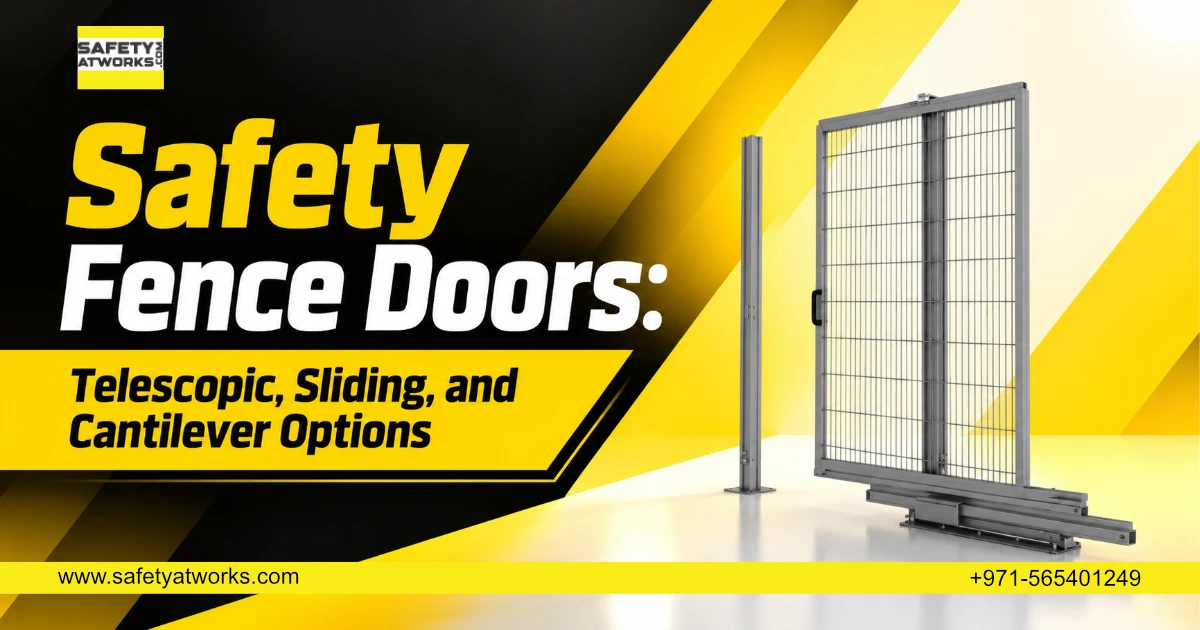
Safety Fence Doors: Telescopic, Sliding, and Cantilever Options
What is a fence without a door? Safety fences can do their job only when the whole area is protected, which includes the points where people enter and exit. Safety fences are designed to grant access to these points, allowing authorized personnel to move in and out of machinery zones or other restricted areas.
That being said, you can’t just choose a safety fence door at random. You need to know how wide the opening needs to be, how often people use the area, the available floor space, and whether equipment like forklifts passes through. Of the different types available, how do you know which suits your workspace? Let’s find out.
What Should a Safety Fence Door Do?
A machine safety fence door’s function extends beyond just providing access, because it should:
- Complete the safety fencing: The door should fit properly with the fence panels and ensure the required level of guarding.
- Control access: It should restrict access to risk-prone areas when the machines are operating.
- Fit your space: The door should open in a way that fits the walkways, machinery, and vehicle traffic.
- Work with the safety system: Operators should be able to connect the door to an interlocking system when required to monitor the opening and closing.
Safety Fence Door Types Compared
Door Type | Opening method | Suited for | Watch out for |
Hinged | Swings open on the hinges | Personnel access | Needs a clear swing space |
Standard sliding door | Moves sideways along the track on the floor | Areas with limited floor space requiring frequent access | Needs enough fence length |
Telescopic sliding | Two or more door leaves slide over each other | Areas needing wide openings. where space is limited | More components to maintain |
Cantilever sliding | Slides sideways without needing a floor track | Forklift and pallet routes | Needs a strong support foundation |
Telescopic Sliding Doors
Telescopic sliding doors are useful when you need a wide opening but your work area doesn’t allow enough space. It consists of two or more leaves that slide over one another, allowing the door to open within a short section of the safety fence.
This is a practical choice for compact workspaces, production areas, machine cells, and similar locations where a hinged door may obstruct the walkway. That being said, maintenance is a major consideration for telescopic doors, because they may have more rollers, guides, and moving components, which often requires regular inspection .
Cantilever Sliding Doors
Cantilever sliding doors also open sideways, with the only difference being that they don’t require a floor track across the opening. These doors are useful for spaces where forklifts, pallet trucks, or other similar equipment need to pass through without hindrance. They are also helpful additions to areas where the floor is frequently cleaned.
However, make sure that the door has a strong and stable support post and foundation and enough clear space for the door to move. Given the dusty and extreme heat conditions of the UAE industries, make sure you choose cantilever doors with suitable finishes.
Standard Sliding and Hinged
Standard sliding doors are a good choice when operators need regular access to, let’s say, machinery without needing any swing movement of the door while opening. The only requirement is that there should be enough free fence length for the door to slide open.
Hinged doors, on the other hand, are more suited for small openings or areas where there is occasional or limited access. They are simple to use, with the only requirement being the availability of enough space to swing the door open without hitting the equipment, walkways, or other structures.
How to Choose the Right Safety Fence Doors
1. Measure the opening
Consider the largest machine component, product, pallet, or maintenance equipment that needs to pass through; this sounds simple but is quite crucial.
2. Consider the traffic around the door
How is the traffic around the opening? Do forklifts, AGVs, pallet trucks, and pedestrians use the same area?
3. Access frequency
Access frequency is yet another factor. There may be doors that are used several times every shift alongside doors that are used only for maintenance.
4. Check the available space
Ensure that there is enough space for a hinged door to swing or a sliding door to move sideways.
5. Compatibility with the existing fence system
The door you choose should suit the height, mesh panels, posts, and hardware of the safety fence.
6. Plan the safety interlock
If the door enables entry to a hazardous machine or area, confirm whether an interlocking or guard-locking device is required.
Interlocking and Machine Safety
Let’s be real: a safety fence door that opens to a hazardous machine or restricted area shouldn’t be treated as a simple entrance. Which is why fixing an interlock switch becomes even more relevant. It helps to monitor the opening and closing of the door by providing a signal to the machine’s control system. Similarly for machines that continue to move even after a stop command, a guard-locking device may be helpful to keep the door closed until the machine halts completely.
Thus, by incorporating them into the safety fencing system, businesses can ensure compliance with safety regulations as proposed by ISO 14120, ISO 14119, ISO 13857, and ISO 13849-1.
Common Safety Fence Door Mistakes
There are some common mistakes you need to be aware of while choosing a safety fence door:
- Not measuring the opening width
- Leaving gaps allowing accidental reach to a guarded area.
- Leaving out the prospect of an interlock.
- Positioning the door where pedestrians or forklifts have poor visibility.
- Choosing a door that is either slow or difficult to operate.
- Forgetting to consider the space for maintaining tracks, rollers, and switches.
Get the Right Safety Fence Door for Your Workspace
So, what is the important takeaway here? Yes, it is to choose a door that people can use easily, access machines and risk areas safely, and ensure complete protection across the workspace. What type of safety fencing door you would need entirely depends on how your machine area is used, the frequency of foot and vehicle traffic, and other site requirements.
If you are searching for a suitable safety fence door, then Safety at Works is your trusted partner. Our team will help you find the right safety fence door in the UAE, based on the opening size, accessibility requirements, and compatibility with the existing fencing system. Contact us today and explore our range of safety fence doors.