-
June 13, 2026
- 0 Comment
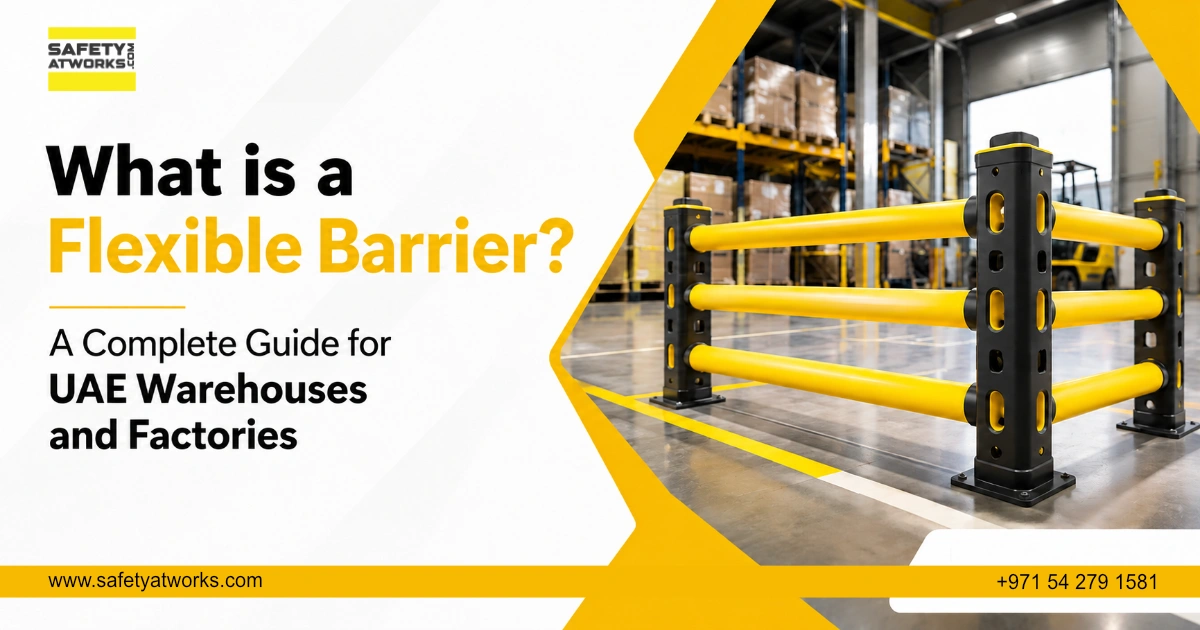
What is a Flexible Barrier? A Complete Guide for UAE Warehouses and Factories
Strength is not always being rigid, sometimes strongest are the
structures that bend and still don’t break. Does any of this ring a bell?
Yes, it’s none other than the flexible safety barriers. Walk into any
modern UAE warehouse or logistics hub and you are likely to see
them.
Unlike the traditional barriers, as their name suggests they can absorb
shock without deforming. As a new barrier that is actively replacing the
traditional steel barriers, it is worth the time to look into what flexible
barriers actually are, how they work and how to choose the right one.
This blog answers all of that.
What Is A Flexible Barrier?
Flexible barriers are industrial safety barriers designed to ensure
effective protection to the machines and personnel while absorbing
impact and returning back to its original position without breaking.
They are made from high density polyethylene or polymers with high
impact resistance.
Flexible barriers carry out some important functions such as:
● Demarcate pedestrian walkways and forklift lanes
● Protect machineries, racking systems and other equipments
● Prevent unauthorized access to restricted areas
● Separating work zones in warehouses and factories
● Create temporary or permanent safety zones
Working Of Flexible Barriers
The flexible barriers are fixed onto the floors with bolts through a
low-profile base plate. As mentioned earlier they are made from high
density polymers with high impact resistance. This way even if a
forklift or pallet truck strikes the barrier, it just deflects and bends, thus
transferring the force fully onto the floor fixing.
Self recovery is the stronghold of flexible barriers as it requires no
replacements and therefore no downtime.
Types of Flexible Barriers
Understanding the major types of flexible barriers will help you choose
a solution that well suits your workspace layout and safety
requirements.
1. Single-Post Flexible Bollards
They are standalone posts that mark columns and pedestrian
boundaries, ideal for tight spaces.
2. Flexible Barrier Systems( Linked panels)
They are a combination of upright posts connected by panels, creating continuous barrier lines. Commonly used for pedestrian walkways, aisle separation and machine perimeter guarding.
3. Modular Flexible Barriers
These systems can be assembled in different shapes and lengths to suit the layout. This is particularly useful in the UAE distribution centers where floor planes are frequently changed.
4. Heavy-duty Flexible Barriers
Suitable for UAE ports and heavy manufacturing plants, these flexible barriers are made from reinforced polymers that can well handle high-speed forklift impacts.
Key Benefits Of Flexible Barriers
Lower Total Cost of Ownership
Given the busy UAE logistics and manufacturing facilities, forklift collisions aren’t new. Flexible barriers easily absorb the impact without deforming. This is such an advantage for industries as it saves the cost of replacing parts and operational downtime.
Enhanced Safety
They are a combination of upright posts connected by panels, creating continuous barrier lines. Commonly used for pedestrian walkways, aisle separation and machine perimeter guarding.
Suited To The UAE’s Climate
They can effectively withstand the high temperature of the UAE. Most of the flexible barriers are designed to resist heat distortion, unlike the traditional barriers which are susceptible to the changing climatic conditions.
Adaptability
Flexible barriers also come in modular models that are well suited for the UAE logistics that tends to change the workspace layout occasionally. They can be easily unbolted, repositioned and reinstalled without hindering the daily operations.
Applications of Flexible Barriers Across The UAE
Flexible barriers are used by diverse industries across the UAE such
as:
- Warehouses and logistics centres (Jebel Ali, KIZAD, DWC free zones)
- Manufacturing and processing plants
- Food and beverage production facilities
- Automotive assembly and service centres
- Ports, container yards, and cargo handling areas
- Pharmaceutical and chemical plants
- Retail distribution centres and cold storage facilities
Compliance To The UAE Safety Regulations
Industrial safety requirements of the UAE are governed by several
regulatory frameworks and some of them are as follows:
- UAE Federal Law No. 8 of 1980 (Labour Law) — requires employers to provide safe working environments
- OSHAD-SF (Abu Dhabi) and Dubai Municipality guidelines for workplace safety
- ISO 13857:2019 — safety distances for safeguarding machinery
- EN 13001 and related standards for crane and lifting equipment safety zones
Flexible barriers help industries to maintain compliance towards these
regulations by clearly defining hazardous zones and preventing the
dangers of collisions from escalating.
How To Choose The Right Flexible Barrier
While choosing the flexible barriers make sure to consider the
following key factors:
Impact Rating
Consider the speed and weight of the forklift or vehicles that are likely to strike them.
Height requirements
Determine whether the barriers should be visible above the pallet loads.
Floor type
The change in floor specifications can affect the anchor depth of the barriers. So consider them accordingly.
Workspace layout
Consider whether the layout changes frequently. If so then choose a modular flexible barrier system.
Heat Exposure
Outdoor or semi outdoor areas need barriers that can withstand high heat.
Colour
Yellow is the standard colour, while red is advised for no-entry or restricted zones.
Conclusion
In short, flexible barriers are a smart investment for the manufacturing,
logistics and warehousing facilities of the UAE. They provide efficient
protection, absorb impact without deforming, survive harsh climatic
conditions, adapt to the changing layout and ensure overall workplace
safety. What more do you need? Of course you need the best flexible
barrier systems and where better to find reliable solutions than Safety
At Works? We supply industry-leading flexible barriers across the UAE
and ensure that your workplace gets the best safety solution it
deserves.